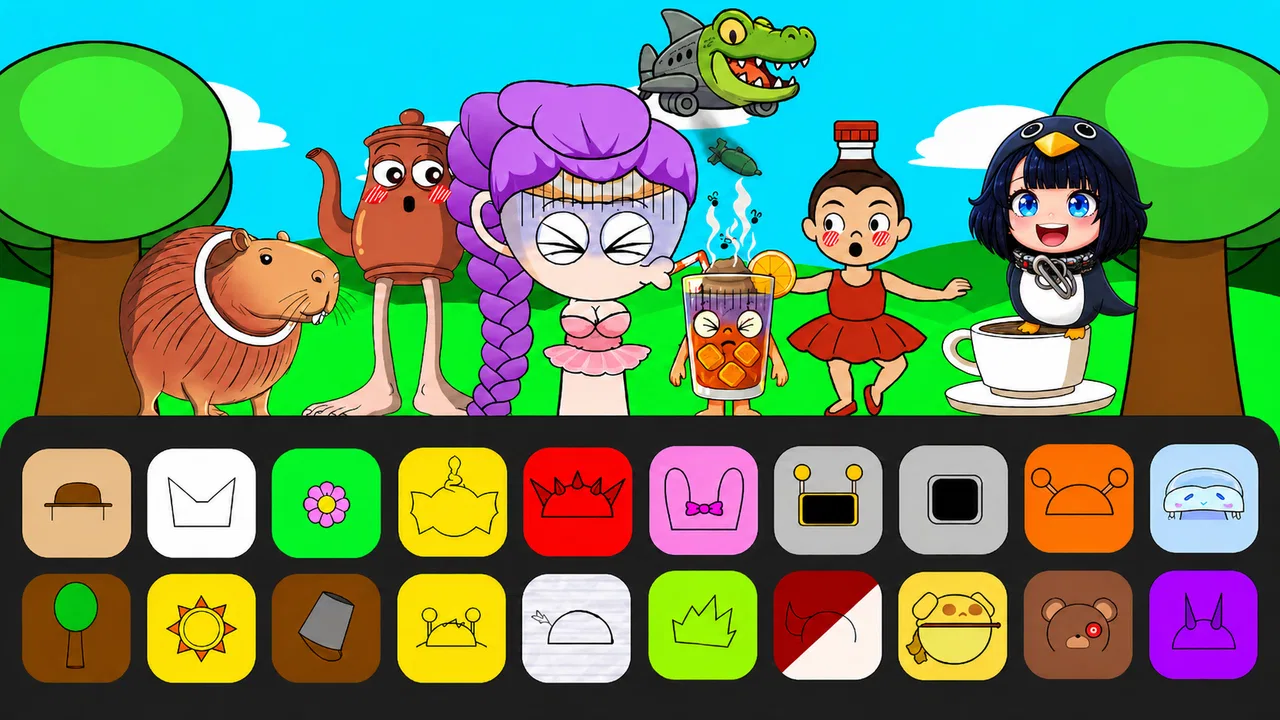
Monster Studio: Music Beats
- 3.0
- Rating
- 10.00M
- Installs
- Free
- Price

 Analysis by App-foxy
I approached Monster Studio: Music Beats as a small creative game rather than a serious music-making tool, and that distinction matters from the first minute. Its central idea is simple: discover monster characters, combine their individual beats, and build a track that feels like your own. I found the appeal in the gradual layering. Instead of asking me to understand musical theory, it lets me listen, experiment, and decide which sounds belong together.
That makes it an easy recommendation for someone who wants a relaxed, sound-focused distraction on a phone. It is a free casual game from Tappy Game, rated for Everyone, and it has already reached over ten million installs. At the same time, its average score sits at around three, which tells me that the concept will not satisfy every player. The experience is charming when I treat it as playful beat discovery, but less convincing if I expect the depth, control, or polish of a full music app.
Why the monster-beat idea works
The strongest capability here is the way each monster contributes to the overall musical texture. I am not simply tapping through a conventional level and chasing a score. I am listening for combinations. One character may give a rhythmic foundation, while another adds a more noticeable phrase, and the fun comes from hearing how those parts interact once they are placed together.
You May Also Like

 Blood Strike: 2.5 Anniversary
Blood Strike’s Loadouts Turn Every Drop Into a Tactical Gamble
A close look at Blood Strike’s custom loadouts: how fast access to signature weapons reshapes its battle royale rhythm, rewards preparation, and narrows the gap between fights.

 Pandora - Music & Podcasts
Pandora’s Music Is Easy to Start, but Harder to Recover
Pandora’s strength is its low-effort path from a seed to a station. Its weak spot is how much confidence it asks you to place in connection, setup, and quiet recovery.

 8 Ball Pool
 Is Built on Rivalries, Rematches, and Routine
A close look at the rivalries, rematches, shared routines, and unanswered safety questions that turn a quick pool match into a persistent mobile community.

 Samsung Music
’s Quiet Strength Is Playing What You Already Own
Its reach comes less from spectacle than from dependable access to a personal library. That simplicity is both the app’s strongest retention engine and its ceiling.

 AccuWeather: Weather Radar
AccuWeather Review: A Quick, Clear Forecast for Everyday Decisions
For everyday plans, the best forecast is the one you can understand quickly. AccuWeather makes rain timing, radar, and local conditions easy to act on, with a few trade-offs.

 Hill Climb Racing
Why Hill Climb Racing Still Turns Crashes Into One More Run
A tiny car, a bumpy hill and one more upgrade: Hill Climb Racing keeps resurfacing because its simple chaos makes every near-miss feel personal.
More From Our News Desk



This approach lowers the barrier to entry. In a traditional beat-making app, I would expect tracks, timelines, instruments, editing controls, and a learning curve before producing anything enjoyable. Here, the creative decision is more immediate: which monster belongs in the mix, and what happens when I combine it with the others? That makes the game approachable even for somebody who has never used a sequencer.
The real strength is instant musical feedback. A choice does not feel abstract because I can hear its effect right away. That feedback encourages experimentation, especially during short sessions. I can try a combination, decide that it feels too busy, remove one element, and listen again. The process is closer to arranging a playful sound collage than composing a finished song, and I think that is exactly where the game is most enjoyable.
The visual theme also gives the audio concept a clear identity. The monsters are not just interchangeable buttons with labels; they frame the experience as a lighthearted discovery game. That presentation helps younger players and casual users understand what to do without a long tutorial. The Everyone age rating fits the friendly tone, although parents should still remember that optional purchases are available inside the free download.
What I actually do during a session
My most useful way to play is to begin with fewer sounds than I think I need. It is tempting to add every available beat immediately, but a crowded mix makes it harder to notice what each monster contributes. I prefer starting with a basic combination, listening for its pulse, and then introducing one new character at a time. This turns the game into a small listening exercise rather than random tapping.
That method also reveals an important trade-off. The game gives me an accessible way to arrange sounds, but it does not replace the control offered by dedicated music software. I am working within the musical identity of the available monsters, not freely selecting tempo, instruments, notes, or recording my own material. For me, that limitation is acceptable during a casual break. It would be frustrating if I wanted to build a precise arrangement or export a polished track for a larger project.
I would also suggest playing with headphones when possible. The point of the experience is hearing how the layers fit together, and a phone speaker can make smaller differences less obvious. This is not a claim about a special audio mode; it is simply a practical way to make the core mechanic easier to judge. If I am testing whether a new monster improves the mix, clearer listening makes the decision more satisfying.
Another useful habit is to pause before changing a combination. The first impression can be misleading when several sounds start together. I like to let the current arrangement run long enough to understand its repeating character, then make a single adjustment. Changing multiple elements at once removes the chance to learn what caused the improvement or problem. That small discipline gives the game more depth than its simple controls initially suggest.
A good fit for short, everyday breaks
The best scenario for me is a short wait: sitting on public transport, taking a break between tasks, or winding down before bed. I can open the game with no preparation, explore a sound combination, and stop without feeling that I have abandoned a complicated campaign. The music-centered interaction provides more involvement than a passive video, while the casual format avoids the pressure of a competitive match.
Imagine having ten minutes before an appointment. A conventional music-production app might feel excessive because opening a project and setting up a workflow could take longer than the break itself. Monster Studio: Music Beats is better suited to that moment because the creative question is immediate. I can focus on one small arrangement, listen to the result, and leave with the feeling that I made a choice rather than merely consumed content.
It can also work as a gentle introduction to layering. A child or first-time player may not know terms such as rhythm, melody, or arrangement, but they can still recognize that one sound changes the character of another. I would use it as a shared activity, asking which monster makes the mix feel calmer, busier, or more energetic. That turns the game into a simple way to talk about listening without turning it into a lesson.
For that reason, I see the game as more than a button-tapping diversion, but less than an educational music course. It encourages attention to patterns and combinations, yet it does not provide the structured explanations or exercises I would expect from a learning app. If the goal is to understand composition formally, another tool would be more appropriate. If the goal is to make sound experimentation feel welcoming, this format has a clear advantage.
Where the free model changes the experience
The download is free, which makes trying the concept easy. However, in-app purchases are listed at up to $29.99 per item, so I would not describe the complete experience as cost-free without qualification. That does not automatically make the game poor value, but it does mean I would approach the purchase screen carefully and decide whether extra content genuinely improves my enjoyment.
My advice is to spend time with the freely available portion before paying for anything. The central question is not whether more monsters sound attractive in theory; it is whether the existing creative loop keeps you interested after the initial novelty. If I already enjoy comparing combinations and returning to adjust them, an optional purchase may feel meaningful. If I am bored once I have heard the basic idea, buying more content is unlikely to solve the underlying problem.
This is also where the average rating of about three becomes useful context. A middling score does not tell me that the game is unplayable, but it does warn me not to expect universal approval. Some players will appreciate the accessible sound-building concept, while others may find the available control too limited or the progression insufficient. I would read that rating as a reason to try it personally rather than as proof that the concept has failed.
The game’s current version is 1.6.1, and it was released on January 15, 2025. Those details place it in a relatively recent part of its life, but they do not change my basic assessment: the experience should be judged by how much pleasure I get from arranging its monster beats, not by expecting the feature set of a mature audio workstation.
How it compares with familiar alternatives
Compared with endless runners or match-style casual games, this one is less about reflexes and more about listening. I do not choose it when I want rapid challenges, a clear score chase, or constant visual action. I choose it when I want a calmer interaction where the result is something I hear rather than something I win.
Compared with a standard music-creation app, it is far easier to understand but much narrower. A professional or semi-professional tool gives me detailed control over timing, notes, effects, and arrangement. That flexibility is valuable when I have a specific musical idea. Monster Studio: Music Beats is better when I want the game to supply the building blocks and let me concentrate on playful combinations.
It also differs from a passive music player. I am not merely selecting a finished playlist; I am influencing the mixture of sounds. That small amount of authorship is the reason I think it can hold attention during a short break. Still, anyone looking for a large listening library, artist discovery, or background music for hours should use a dedicated streaming service instead.
The closest comparison is probably another character-based beat toy, but even there I would separate the experiences by purpose. This game is most useful when the act of discovering and combining sounds is enough. It is not the right choice for someone who needs saved production projects, detailed editing, or a guaranteed path from an idea to a finished song. Its value is in the playful middle ground between a toy and a lightweight creative activity.
Small decisions that make it more enjoyable
I found three practical approaches especially helpful. First, I listen to each new layer on its own before judging the complete arrangement. That prevents a strong existing beat from hiding a quieter contribution. Second, I keep a mental note of combinations I like instead of changing everything immediately. This makes it easier to return to a satisfying sound after experimenting. Third, I treat unusual combinations as experiments rather than mistakes. A mix that sounds strange at first can become interesting once I understand its repeating pattern.
These habits matter because the game’s simplicity can otherwise encourage random interaction. If I tap quickly without listening, the experience becomes shallow. If I slow down and compare changes, I get a more personal result and a better sense of why one arrangement works for me. The game does not need complex controls to reward attention; it just needs me to use the controls deliberately.
I would also avoid judging the game after only one rushed session. Its appeal is not a dramatic opening sequence. The satisfaction comes from noticing small differences between arrangements and deciding which mood I prefer. On the other hand, I would not force myself to continue if that kind of comparison feels repetitive. The same focused simplicity that makes it accessible can make it feel limited to players who need frequent goals or stronger progression.
Who should install it
I think it is a good match for casual players who enjoy music, cute character themes, and low-pressure experimentation. It is particularly suitable for people who want an activity that can be understood quickly and stopped easily. Families may also find it approachable because the basic idea is easy to demonstrate: choose monsters, combine their beats, and listen to the result.
It may appeal to aspiring producers as a playful warm-up. I would not use it to replace a digital audio workstation, but I could use it to think about contrast, repetition, and how separate parts share space. Someone who feels intimidated by technical music software may find this a friendlier first step before moving to a more advanced alternative.
I would skip it if my priority is competitive gameplay, a deep progression system, or precise musical authorship. I would also be cautious if I dislike in-app purchase prompts or want every creative option included without considering extra spending. The free entry point is helpful, but the listed price of $29.99 for an individual purchase means the financial side deserves attention, especially for families sharing a device.
Device compatibility is relatively broad because the minimum operating system is Android 7.1, though the experience can still vary with screen size, speaker quality, and general device performance. I would make sure the phone or tablet is comfortable for listening before deciding whether it is a keeper. Since the game’s main reward is musical, poor audio output can reduce the appeal more than it would in a purely visual casual title.
There are around 4.7 thousand ratings and 113 written reviews, alongside more than ten million installs. I take that reach as evidence that the basic idea is easy for many people to try, not as proof that it will suit everyone. The numbers give the game visibility, while my own recommendation remains conditional: install it for the monster-based beat experimentation, not because you expect a full production studio.
My final view is positive but measured. Monster Studio: Music Beats succeeds when I let it be a compact musical toy with a game-like presentation. Its best feature is the immediate effect of combining monster sounds, and that capability can turn a few spare minutes into a small creative session. The lack of deeper control will be a genuine limitation for experienced music makers, and the in-app purchase structure means I would explore first and spend later, if at all.
For the right person, that simplicity is not a weakness. It is the reason the game feels approachable. I would recommend it to a friend who wants a calm, sound-driven casual game and enjoys making small choices with an audible result. I would point a serious composer toward a dedicated music app instead. Knowing that boundary is the key to enjoying what Tappy Game has made: not a replacement for music production, but an inviting way to play with beats.
FAQs for Monster Studio: Music Beats
01What is Monster Studio: Music Beats?
Monster Studio: Music Beats is a music-making game and creative app where you combine colorful monster characters to build songs from different sound loops. Each character contributes vocals, rhythms, melodies, or effects, allowing you to experiment with arrangements and create tracks without needing formal musical experience. Its visual style and simple controls make it approachable for casual players and beginners.
02How does the gameplay work in Monster Studio: Music Beats?
The main experience revolves around selecting and placing monster performers into an arrangement, then listening to how their individual sounds work together. You can usually change the lineup, remove characters, and try different combinations to discover new musical results. Progress is based more on experimentation and creativity than on traditional levels, combat, or difficult skill-based challenges.
03Can beginners create music without knowing how to play an instrument?
Yes. Monster Studio: Music Beats is designed around ready-made sound parts, so you do not need to understand musical notation, mixing, or instruments to get started. The interface generally uses visual buttons and drag-and-drop-style interactions, making it easy to test ideas. Beginners can create enjoyable combinations quickly, while more experienced users may spend time refining the mood and structure of a track.
04Does Monster Studio: Music Beats require an internet connection or include in-app purchases?
Requirements can vary depending on the version and platform, so it is worth checking the app-store listing before downloading. Basic music creation may be available offline, but advertisements, updates, cloud features, or certain unlockable content could require an internet connection. If the app offers optional purchases, review the pricing and parental-control settings before allowing children to use it.
05Is Monster Studio: Music Beats suitable for children?
The colorful characters and straightforward music-building mechanics make Monster Studio: Music Beats appealing to younger players, especially those interested in rhythm and creative activities. However, parents should check the current age rating, advertising policy, privacy information, and any online or purchase features on the relevant store page. Supervision is recommended if the device is linked to a payment method or social features.
Pros
- Simple beat-making tools are easy for beginners to understand.
- Loop-based creation makes it quick to build complete tracks.
- Useful for experimenting with rhythm
- tempo
- and musical ideas.
- Touch controls make arranging sounds feel intuitive on mobile devices.
- Good option for short creative sessions without complex music theory.
Cons
- The sound library may feel limited for experienced producers.
- Advanced mixing and detailed editing options are relatively scarce.
- Some features or sound packs may require in-app purchases.
- Projects can become repetitive without importing custom audio.
- Performance may vary on older phones when using several effects.

Monster Studio: Music Beats
Gallery